What is SEO and how does it work?
What is Search Engine Optimization (SEO)?
Let’s start by asking an obvious question: what exactly is SEO?
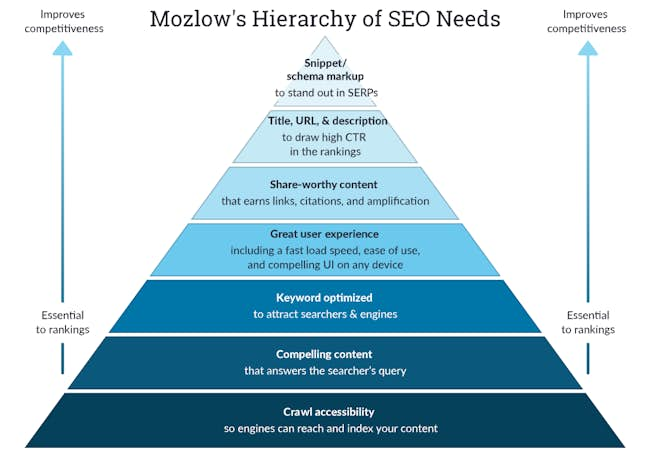
SEO stands for ‘Search Engine Optimization’, which is the process of getting traffic from free, organic, editorial, or natural search results in search engines. It aims to improve your website’s position in search results pages (SERPs). Remember, the higher the website is listed, the more people will see it.There’s a great graphic created by Rand Fiskin, co-founder of Moz, that takes from Maslow's Hierarchy of Needs’ pyramid. Fishkin’s ‘Mozlow's Hierarchy of SEO Needs’ looks at how people should execute SEO.
Top tip: SEO is no longer confined to search engines like Google or Bing. It’s also important for social networks such as YouTube and TikTok as people turn to social media to find information.
What are the three pillars of SEO?
As a digital marketer, knowing how to get your brand, website, or company found by searchers is a core skill, and understanding how SEO is evolving will keep you at the top of your game.
While SEO changes frequently in small ways, its key principles do not. We can break SEO into three core components or pillars that you need to be familiar with – and action regularly:
Technical Optimization: Technical Optimization is the process of completing activities on your site that are designed to improve SEO but are not related to content. It often happens behind the scenes. A simple example of technical optimization is submitting your sitemap to Google.
On-Page Optimization: On-Page Optimization is the process of ensuring the content on your site is relevant and provides a great user experience. It includes targeting the right keywords within your content and can be done through a content management system like WordPress, Wix, Drupal, Joomla, Magento, or Shopify.
Off-Page Optimization: Off-Page Optimization is the process of enhancing your site’s search engine rankings through activities outside of the site. This is largely driven by high-quality backlinks, which help to build the site’s reputation.
 |
How Does SEO Work?
How Does SEO Work & Why Is It Important?
There are entire text books (or maybe eBooks in this case) that detail how exactly SEO works, how to cater to its preferences and why it’s critical for anyone with a website. At a higher level, SEO can be broken down like this:
Nearly all online traffic is driven by search engines (think Google, Bing, etc.).
- Search engines populate both organic and paid results based on dynamic algorithms that crawl the internet looking for the most relevant results to the query.
- SEO utilizes things like keywords, internal and external links, and optimized content to help search engines find content and rank websites higher on search engine results pages (SERPs).
It is important to understand that the way search engines crawl and rank content is constantly changing, so SEO experts have to regularly update and refresh their tactics to keep their content and websites relevant. This is also what makes SEO so important — an organization that wants high SERP rankings to increase their traffic needs to implement the most effective SEO strategies, such as:
Focus on user experience
- Implement non-manipulative ranking tactics
- Understand searcher intent/behavior
- Monitor the latest search engine algorithms
Types of SEO: On-Page SEO vs. Off-Page SEO
So what does an SEO strategy look like? Start by breaking it down into on-page SEO and off-page SEO tactics. These are obviously related, but each type has its own unique nuances that will help your efforts be more effective.

On-page SEO: As the name suggests, on-page SEO analyzes what the page (and your website) are about. On-page SEO strategy focuses on optimizing the content hosted on your own website, so things like your title tags, page content, site speed and more. To optimize this content, you need to understand the relevant keywords your audience is looking for and use that as a guide to build your site content.
Off-page SEO: This involves everything that is not on your own website. Off-page SEO determines how authoritative your content is, which is typically achieved through backlinks from other websites. Backlinks are links from an outside website back to your site.
To understand how these two types of SEO impact your site performance, think of it this way: on-page SEO determines what you rank for and off-page SEO determines how well you rank.
5 Highest Paying Careers in SEO and Marketing Analytics
Find out how to launch your career in one of the most exciting and top earning fields — SEO and marketing analytics.

SEO Strategy Basics
Every SEO specialist has slightly different recommendations for what your SEO strategy should include. Neil Patel, a New York Times bestselling author and widely renowned digital marketing expert, recommends that everyone include the following elements in a successful SEO strategy:
Understand user intent: Craft your content with the understanding of the searcher’s end goal so you can help them accomplish their goal.
- Develop a customer avatar: Audience, audience, audience. Any SEO strategist starts by learning more about who your reader is, what they like, what they dislike, and why they’re there.
- Break up the text: Keeping it simple is key, as most people have short attention spans and limited time. Break up copy with bullets, images, headers and short sentences.
- Make it actionable: Your content should both give the searcher what they are looking for and guide them to the next steps. That way they have both an answer and an actionable outcome.
9 Core Elements of SEO
As you move into the world of digital marketing and SEO, people will start throwing around terms and phrases that you don’t understand. With all that jargon, it helps to have a quick glossary of SEO elements and terms. Here are some of the most common:
Audience: Audience, sometimes referred to as the target audience, is “a group of consumers characterized by behavior and specific demographics. Target audiences are a pillar of most businesses influencing decision making for marketing strategy, such as where to spend money on ads, how to appeal to customers, and even what product to build next.” Determining the target audience will influence nearly every other aspect of SEO.
- Searcher Intent: This term is used interchangeably with user intent and audience intent, and it refers to the purpose of an online search. There are four types of searcher intent:
Informational intent
- Navigational intent
- Transactional intent
- Commercial investigation
- Keywords: Keywords are “any search term entered into Google (or another search engine) that has a results page where websites are listed.” The term is slightly misleading, as a keyword can be a singular word or a phrase that has multiple words in it. Keywords are used by marketers to optimize website content to help sites and pages rank higher.
Meta Description: Meta descriptions get a bit more into the technical aspect of search engines, but they greatly influence SERPs. Meta descriptions are “an HTML element that provides a brief summary of a web page. A page’s meta description tag is displayed as part of the search snippet in a search engine results page (SERP) and is meant to give the user an idea of the content that exists within the page and how it relates to their search query.”
- Content: Just as it sounds, content is any text, audio or visual material that appears on your website. Believe it or not, all of those components can be improved with SEO tactics. Content is king is an overused phrase in the world of digital marketing, but it’s actually true. Content is the main ingredient of any website, and it should be the central focus of SEO strategy and improvements.
- Backlinks: Backlinks are sometimes referred to as inbound and incoming links, and they are part of any off-page SEO strategy. Backlinks are created when one website links back to another — in the case of improving SEO, you want to have as many backlinks as you can. Backlinks show Google that you are an authority on a particular topic and essentially work as a “vote of confidence” from one website to another.
Site Architecture: Site architecture is “the hierarchical structure of your website pages. This structure is reflected through internal linking. Your website’s structure should help users easily find information and help search engine crawlers understand the relationship between different pages.” Google and other search engines take into account how well — or how poorly — your site is organized. The easier it is for a user to navigate, the higher it will likely rank.
- Site Speed: Just as it sounds, site speed is “how quickly users are able to see and interact with content.” As we’ve mentioned before, the path between the user and your content needs to be as direct as possible, and speed plays an important role. If your site is slow to load, loads in stages or returns a 404 message (this is the worst case scenario), search engines will ding you for that. Optimizing search speed is an important element of good SEO and can mean the difference between ranking on page one and page two.
Schema: Another more technical aspect of SEO is schema. Schema is “a structured data vocabulary that helps search engines better understand the info on your website in order to serve rich results. These markups allow search engines to see the meaning and relationships behind entities mentioned on your site. For this reason, schema markup has become a hot topic of SEO.”
SEO Tips for Beginners
SEO is a complex and constantly evolving specialty that can stump even the most seasoned professionals. One of the best ways to build a solid foundation — especially for SEO beginners — is to start with a comprehensive SEO education. Here are some great resources:
There are also more formal education options that focus on SEO and digital marketing. At the University of San Diego Division of Professional and Continuing Education (PCE), we offer a Fundamentals of Search Engine Optimization (SEO) and Marketing Analytics Program that features multiple classes covering all aspects of search engine marketing and search engine optimization.

Comments
Post a Comment